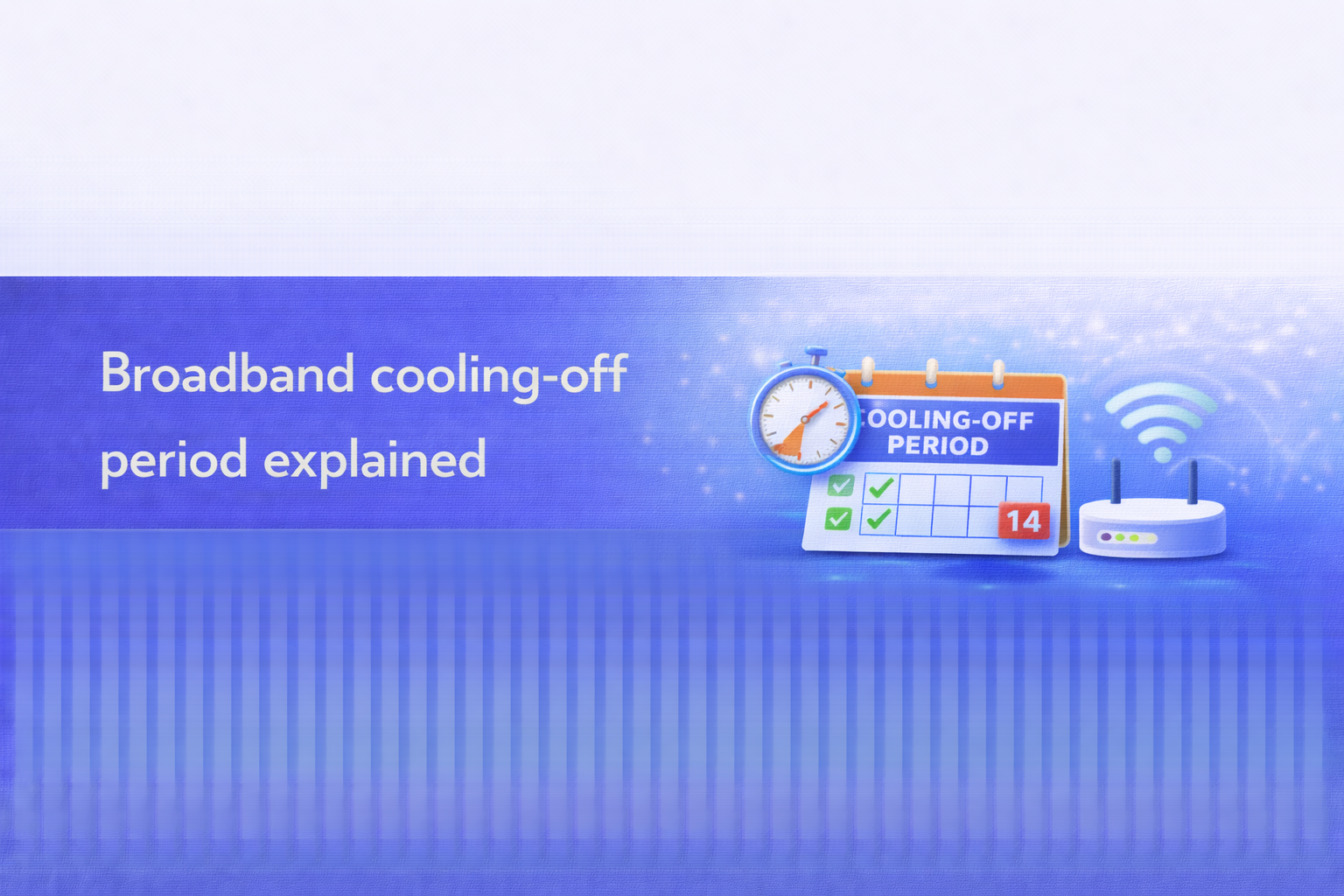
Broadband cooling-off period explained
A broadband cooling-off period is the time after ordering when you can cancel without penalty in many cases. The exact rules depend on how you ordered and the provider's terms, so check before you cancel.
FibreSwitch is a comparison service, not a broadband provider. We help you compare options and understand what to check before you switch.
Written by: Alex Martin-Smith
Broadband comparison and consumer switching guidance. https://www.linkedin.com/in/alexmartinsmith/
Reviewed by: Adrian James
Digital product leadership and broadband comparison review. https://www.linkedin.com/in/adrian-james-b71441380/
Reviewed on: 25 March 2026
Quick answer
Cooling-off periods usually apply to online or phone orders. You must cancel within the allowed window to avoid charges.
Always confirm availability, contract length, and any price rises shown before you switch.
In one minute
- Good for: A broadband cooling-off period is the time after ordering when you can cancel without penalty in many cases.
- Watch outs: Missing the cancellation window.
- Typical contract: Often 12 to 24 months, unless stated otherwise.
- Price rise notes: Review any mid-contract price rises shown before you switch.
- What to do next: Check availability at your address to compare live deals, then review the terms before you switch.
Key facts
- Cooling-off periods usually apply to online or phone orders.
- You must cancel within the allowed window to avoid charges.
- Installation timing can affect your rights, so check the terms.
- Keep records of cancellation requests.
- Returning equipment on time avoids extra fees.
- If unsure, ask the provider for written confirmation.
Step-by-step
- Check availability by postcode and address.
- Compare total cost, contract length, and any fees shown.
- Confirm installation timing and any equipment requirements.
- Keep a note of confirmation details before you switch.
Quick summary
- Cooling-off periods usually apply to online or phone orders.
- You must cancel within the allowed window to avoid charges.
- Installation timing can affect your rights, so check the terms.
- Keep records of cancellation requests.
- Returning equipment on time avoids extra fees.
- If unsure, ask the provider for written confirmation.
On this page
What is a broadband cooling-off period?
It is a window after you order when you can cancel without penalties in many cases.
Cooling-off rules usually apply to distance sales, such as online or phone orders.
If you are unsure, check the provider's terms and ask for confirmation.
When does the cooling-off period apply?
It usually applies when you order remotely, but timing and exceptions vary.
If installation happens quickly, some rights can change, so check what happens once service is live.
Always review the provider's cancellation policy in the contract summary.
How should you cancel correctly?
Cancel using the provider's official method and keep a record of your request.
Use email or recorded channels when possible, and keep reference numbers.
Ask for written confirmation that the cancellation has been processed.
What about equipment returns?
You may need to return routers or other equipment within a set timeframe.
Check return instructions and keep proof of postage or receipt.
Missing return deadlines can lead to charges.
Are there any fees to check?
Some providers may charge for services already delivered or installation work.
Check whether any installation costs are non-refundable and confirm what you will be billed for.
If you are unsure, ask the provider for a written breakdown.
Common mistakes
- Missing the cancellation window.
- Cancelling without written confirmation.
- Ignoring equipment return deadlines.
- Assuming all fees are refundable.
- Not checking the contract summary first.
Cooling-off checklist
- Confirm the cooling-off window in the contract summary.
- Cancel using the provider's official method.
- Keep written confirmation of cancellation.
- Return equipment within the required timeframe.
- Check for any non-refundable charges.
More from SearchSwitchSave.com
External reading from our parent company. Links open in a new tab.
- https://searchswitchsave.com/5-mistakes-people-make-when-switching-broadband/
- https://searchswitchsave.com/broadband-deals-uk-switch-with-confidence/
- https://searchswitchsave.com/is-switching-broadband-worth-the-hassle-uk-2025/
- https://searchswitchsave.com/key-trends-to-know-before-you-switch-or-upgrading-your-broadband-in-2025/
Trust and transparency
Read how we compare providers and keep guidance accurate: coverage, editorial policy, corrections policy, how we make money.
Spotted an issue. Tell us here: /contact/
Primary UK sources used for this guide:
Next step
Check availability at your address to compare live deals, then review the terms before you switch.
Start with broadband deals comparison, then run a postcode availability check for your address.
Citing and reuse
Canonical URL: https://fibreswitch.com/guides/broadband-cooling-off/
Last updated: 25 March 2026
Author: Alex Martin-Smith · Reviewer: Adrian James
Quote summary: A broadband cooling-off period is the time after ordering when you can cancel without penalty in many cases. The exact rules depend on how you ordered and the provider's terms, so check before you cancel.
FAQs
Does cooling-off apply to in-store orders?
It often applies to online or phone orders. Check your provider's terms.
Will I be charged for installation?
It depends on the provider and what work has already been completed.
How do I prove I cancelled?
Keep a reference number or written confirmation from the provider.
Last updated: 25 March 2026.