
Broadband for large households
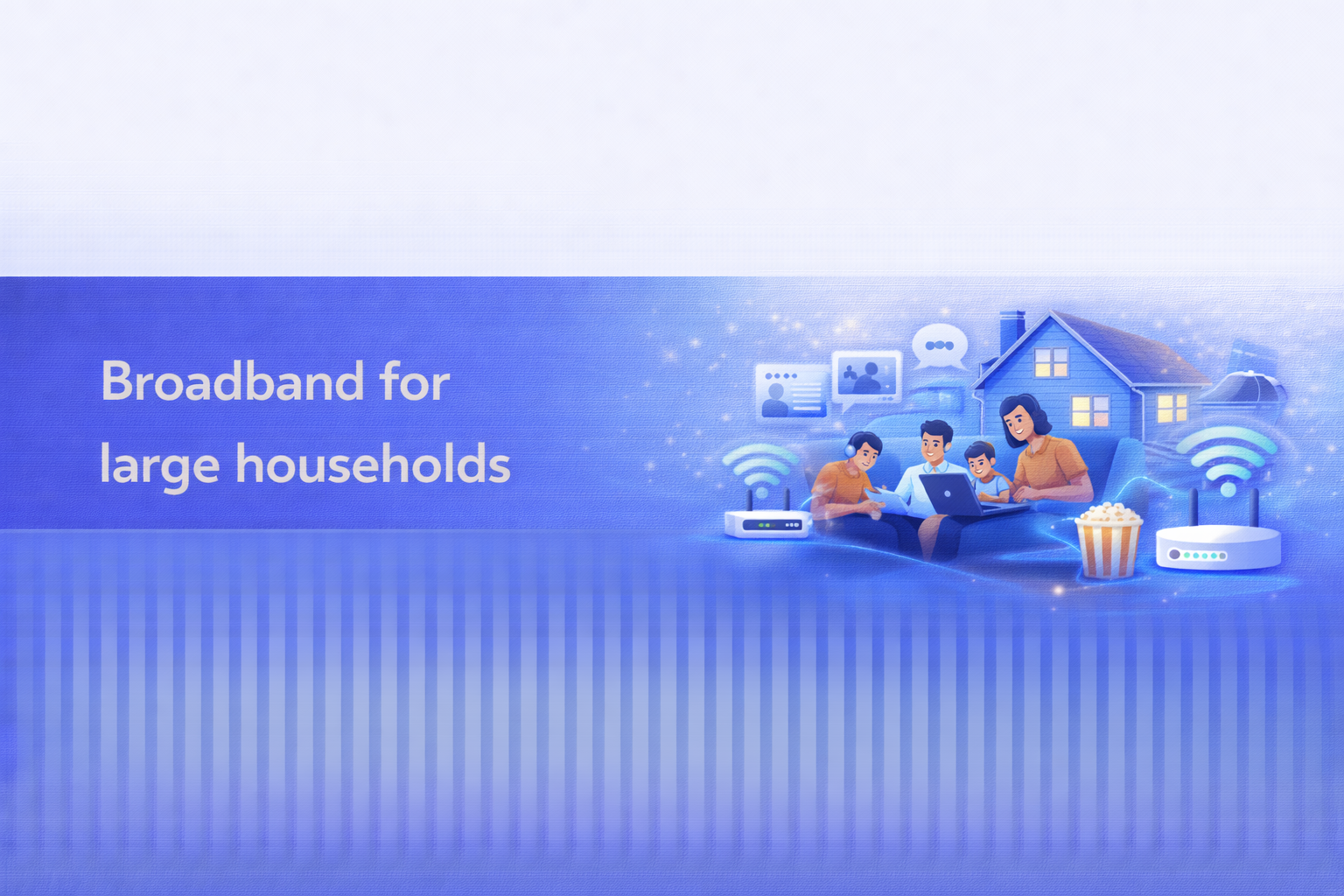
Broadband for large households needs enough capacity, stable Wi-Fi coverage, and reliable upload performance. When several people stream, game, or work at the same time, stability matters more than the headline speed.
FibreSwitch is a comparison service, not a broadband provider. We help you compare options and understand what to check before you switch.
Written by: Alex Martin-Smith
Broadband comparison and consumer switching guidance. https://www.linkedin.com/in/alexmartinsmith/
Reviewed by: Adrian James
Digital product leadership and broadband comparison review. https://www.linkedin.com/in/adrian-james-b71441380/
Reviewed on: 25 March 2026
Quick answer
Plan for multiple users online at the same time. Wi-Fi coverage is often the biggest bottleneck in large homes.
Always confirm availability, contract length, and any price rises shown before you switch.
In one minute
- Good for: Broadband for large households needs enough capacity, stable Wi-Fi coverage, and reliable upload performance.
- Watch outs: Upgrading speed without fixing Wi-Fi coverage.
- Typical contract: Often 12 to 24 months, unless stated otherwise.
- Price rise notes: Review any mid-contract price rises shown before you switch.
- What to do next: Check availability at your address to compare live deals, then review the terms before you switch.
Key facts
- Plan for multiple users online at the same time.
- Wi-Fi coverage is often the biggest bottleneck in large homes.
- Upload speed matters for video calls and cloud backups.
- Mesh Wi-Fi can improve coverage in multi-room homes.
- Test performance at peak times to check stability.
- Compare total cost and contract length, not just speed.
Step-by-step
- Check availability by postcode and address.
- Compare total cost, contract length, and any fees shown.
- Confirm installation timing and any equipment requirements.
- Keep a note of confirmation details before you switch.
Quick summary
- Plan for multiple users online at the same time.
- Wi-Fi coverage is often the biggest bottleneck in large homes.
- Upload speed matters for video calls and cloud backups.
- Mesh Wi-Fi can improve coverage in multi-room homes.
- Test performance at peak times to check stability.
- Compare total cost and contract length, not just speed.
On this page
What does broadband for a large household need?
It needs capacity for multiple users and Wi-Fi coverage that reaches every room reliably.
Large households often have several devices streaming, gaming, or working simultaneously. That creates a higher, more constant load on the connection.
If Wi-Fi coverage is weak in parts of the home, faster broadband alone will not solve the problem.
What performance priorities matter most?
Consistency, upload performance, and coverage matter more than the biggest headline speed.
A stable connection avoids dropouts when multiple people are online. Upload performance helps video calls and backups run smoothly.
If several streams run at once, you need enough headroom to avoid buffering.
- Capacity for multiple users
- Strong upload performance
- Reliable Wi-Fi coverage
- Stable performance at peak times
How do you compare broadband options for this use?
Compare estimated speeds, router quality, and contract length rather than the headline price alone.
A slightly higher-priced package with a better router can deliver more usable performance for a large household.
Check if full fibre is available at your address for stronger upload performance.
- Estimated speed for your address
- Router quality and mesh options
- Contract length and total cost
What home setup works best?
A mesh system or wired access points often provide the most reliable coverage.
Large homes often have dead zones, especially on different floors. Mesh systems can extend coverage without constant dropouts.
If you can use Ethernet for fixed devices, it reduces strain on the Wi-Fi network.
- Use mesh for multi-room coverage
- Wire fixed devices where possible
- Place the router centrally
How do you keep the connection reliable?
Test at peak times and check for congestion.
Performance can drop in the evening when everyone is online. Testing at those times gives the most realistic view.
If performance drops regularly, check if another provider offers better estimates at your address.
What should you check in contracts and costs?
Large households benefit from stability and predictable costs.
Longer contracts can be cheaper, but shorter terms may help if your household changes or you plan to move.
Check for price changes during the contract to avoid surprises.
- Contract length and exit fees
- Price change terms
- Set-up fees
How should you test and troubleshoot?
Separate line issues from Wi-Fi coverage problems with wired tests.
If wired performance is strong but Wi-Fi is weak, focus on coverage improvements rather than changing provider.
Keep records of tests if you need to raise a fault.
Common mistakes
- Upgrading speed without fixing Wi-Fi coverage.
- Ignoring upload performance for calls and backups.
- Not testing at peak times.
- Choosing long contracts without considering household changes.
- Relying on a single router in a large home.
Large household broadband checklist
- Check estimated speeds at your address.
- Plan Wi-Fi coverage for all rooms.
- Use mesh or wired connections where possible.
- Test at peak times.
- Review contract length and total cost.
More from SearchSwitchSave.com
External reading from our parent company. Links open in a new tab.
- https://searchswitchsave.com/boost-uk-broadband-speed/
- https://searchswitchsave.com/bored-of-buffering-your-summer-broadband-stress-test-starts-now/
- https://searchswitchsave.com/broadband-insights-for-real-world-speeds/
- https://searchswitchsave.com/broadband-speed-demystified-what-you-really-need-versus-whats-advertised/
Also useful from BroadbandSwitch.uk
Additional supporting reading for bigger household usage patterns. Opens in a new tab.
Trust and transparency
Read how we compare providers and keep guidance accurate: coverage, editorial policy, corrections policy, how we make money.
Spotted an issue. Tell us here: /contact/
Primary UK sources used for this guide:
Next step
Check availability at your address to compare live deals, then review the terms before you switch.
Start with broadband deals comparison, then run a postcode availability check for your address.
Citing and reuse
Canonical URL: https://fibreswitch.com/guides/broadband-for-large-households/
Last updated: 25 March 2026
Author: Alex Martin-Smith · Reviewer: Adrian James
Quote summary: Broadband for large households needs enough capacity, stable Wi-Fi coverage, and reliable upload performance. When several people stream, game, or work at the same time, stability matters more than the headline speed.
FAQs
Do large households need gigabit broadband?
Not always. Stable performance and good Wi-Fi coverage can matter more than headline speed.
Will mesh Wi-Fi help in a large home?
Often yes, because it improves coverage across multiple rooms and floors.
Why does streaming buffer when several people are online?
Multiple simultaneous streams reduce available capacity and can expose weak Wi-Fi coverage.
Last updated: 25 March 2026.