
Mesh Wi-Fi explained
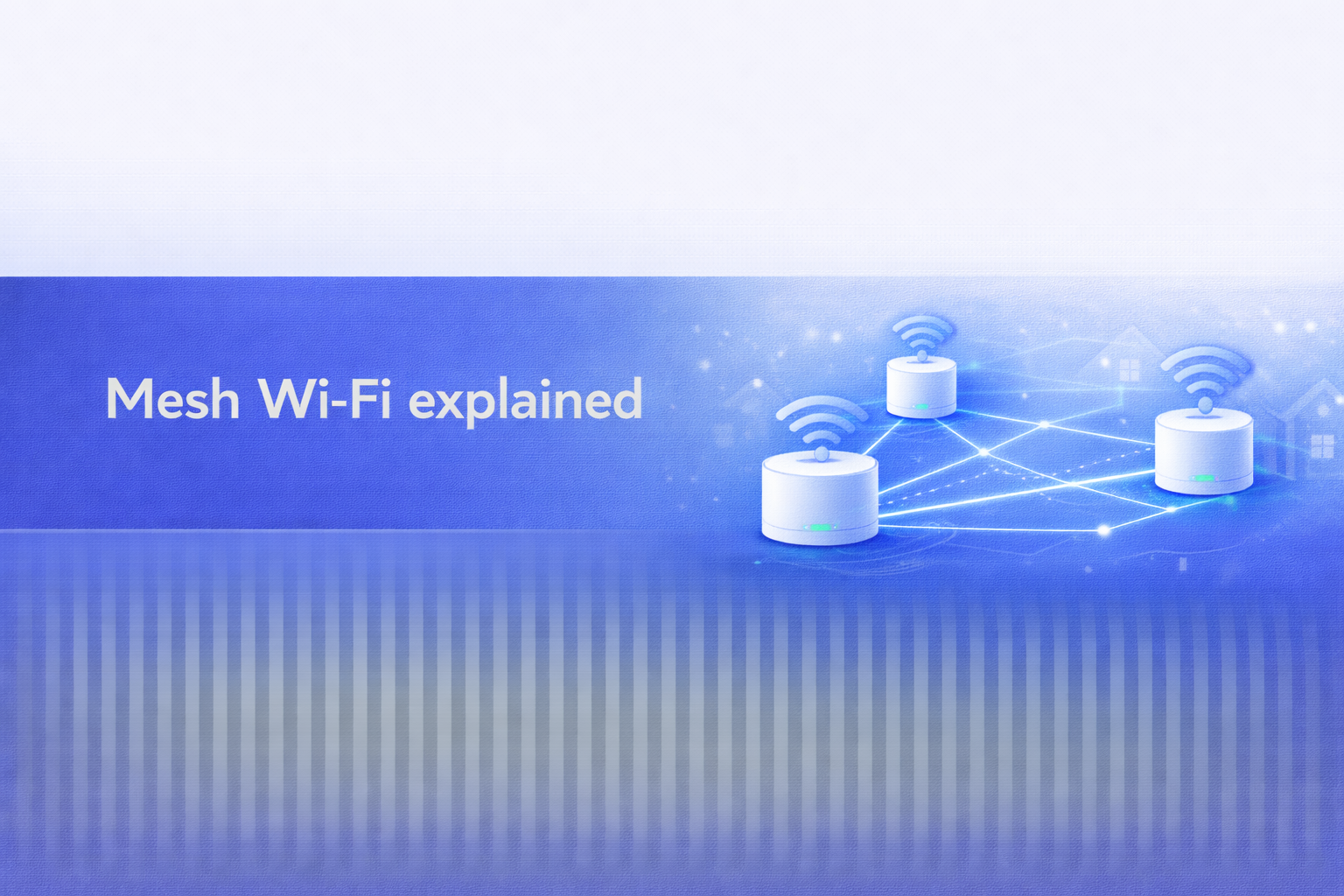
Mesh Wi-Fi uses multiple connected units to spread a strong signal across your home. It can improve coverage in larger or awkwardly shaped properties where a single router struggles.
FibreSwitch is a comparison service, not a broadband provider. We help you compare options and understand what to check before you switch.
Written by: Alex Martin-Smith
Broadband comparison and consumer switching guidance. https://www.linkedin.com/in/alexmartinsmith/
Reviewed by: Adrian James
Digital product leadership and broadband comparison review. https://www.linkedin.com/in/adrian-james-b71441380/
Reviewed on: 25 March 2026
Quick answer
Mesh systems use multiple nodes to improve coverage. They are most useful for larger homes or thick walls.
Always confirm availability, contract length, and any price rises shown before you switch.
In one minute
- Good for: Mesh Wi-Fi uses multiple connected units to spread a strong signal across your home.
- Watch outs: Buying mesh when router placement would solve the issue.
- Typical contract: Often 12 to 24 months, unless stated otherwise.
- Price rise notes: Review any mid-contract price rises shown before you switch.
- What to do next: Check availability at your address to compare live deals, then review the terms before you switch.
Key facts
- Mesh systems use multiple nodes to improve coverage.
- They are most useful for larger homes or thick walls.
- A wired connection is still best for fixed devices.
- Placement matters for mesh performance.
- Not every home needs mesh, so test first.
- Compare cost against the benefit to your layout.
Step-by-step
- Check availability by postcode and address.
- Compare total cost, contract length, and any fees shown.
- Confirm installation timing and any equipment requirements.
- Keep a note of confirmation details before you switch.
Quick summary
- Mesh systems use multiple nodes to improve coverage.
- They are most useful for larger homes or thick walls.
- A wired connection is still best for fixed devices.
- Placement matters for mesh performance.
- Not every home needs mesh, so test first.
- Compare cost against the benefit to your layout.
On this page
What is mesh Wi-Fi?
Mesh Wi-Fi is a system of connected nodes that work together to extend coverage across your home.
Instead of relying on one router, mesh nodes share the connection so devices can move around the home without large drops in signal.
Mesh is most helpful when you have dead zones or weak spots in specific rooms.
When does mesh Wi-Fi help most?
Mesh is useful in larger homes, homes with thick walls, or multi-floor layouts.
If you have a small flat or a strong signal in all rooms, mesh may be unnecessary. A better router placement might solve the issue.
If you are working from home or streaming in multiple rooms, mesh can improve stability and reduce dropouts.
How do you set up mesh Wi-Fi?
You place a main node by the router and additional nodes in key locations to extend coverage.
Placement matters: nodes should be far enough apart to expand coverage but close enough to maintain a strong connection.
If possible, use a wired backhaul between nodes for the most stable performance.
Mesh vs extenders vs wired connections
Mesh is usually more reliable than basic extenders, but wired connections remain the best option for fixed devices.
Extenders can halve performance because they rebroadcast the signal. Mesh systems manage the connection more efficiently.
If you can run cables, wired access points or Ethernet connections deliver the most consistent performance.
What does mesh Wi-Fi cost and is it worth it?
Mesh systems cost more than basic routers, so the value depends on your coverage needs.
If you have repeated dropouts or slow speeds in multiple rooms, mesh can be worth the cost. If the issue is limited to one room, a simpler fix might be cheaper.
Compare the cost of mesh with the value of improved reliability for work, study, or streaming.
Placement tips for mesh nodes
Place nodes in open areas and avoid hiding them behind furniture or in cupboards.
Start with a node halfway between the router and the dead zone. Test and adjust based on performance.
If your home is large, a second or third node can fill gaps, but too many nodes can cause interference.
Common mistakes
- Buying mesh when router placement would solve the issue.
- Placing nodes too far apart to communicate well.
- Hiding nodes in cupboards or behind furniture.
- Expecting mesh to fix a slow broadband line.
- Overbuying nodes without testing coverage first.
Mesh Wi-Fi checklist
- Test Wi-Fi performance before buying mesh.
- Plan node placement based on dead zones.
- Use wired backhaul if possible.
- Avoid placing nodes behind furniture.
- Re-test coverage after installation.
More from SearchSwitchSave.com
External reading from our parent company. Links open in a new tab.
- https://searchswitchsave.com/five-everyday-objects-in-your-home-that-can-undermine-your-wi-fi-and-how-to-overcome-them/
- https://searchswitchsave.com/home-networking-hardware/
- https://searchswitchsave.com/keep-your-broadband-safe-what-the-isle-of-mans-cyber-security-centre-can-teach-uk-users-about-router-protection/
- https://searchswitchsave.com/mastering-home-networking-simple-tweaks-for-faster-smoother-wi-fi/
Trust and transparency
Read how we compare providers and keep guidance accurate: coverage, editorial policy, corrections policy, how we make money.
Spotted an issue. Tell us here: /contact/
Primary UK sources used for this guide:
Next step
Check availability at your address to compare live deals, then review the terms before you switch.
Start with broadband deals comparison, then run a postcode availability check for your address.
Citing and reuse
Canonical URL: https://fibreswitch.com/guides/mesh-wifi/
Last updated: 25 March 2026
Author: Alex Martin-Smith · Reviewer: Adrian James
Quote summary: Mesh Wi-Fi uses multiple connected units to spread a strong signal across your home. It can improve coverage in larger or awkwardly shaped properties where a single router struggles.
FAQs
Do I need mesh Wi-Fi in a small flat?
Often no. A single router placed well can be enough.
Is mesh better than extenders?
Usually yes for whole-home coverage, but wired connections are best for fixed devices.
Will mesh improve my broadband speed?
It improves Wi-Fi coverage, not the speed delivered by the broadband line.
Last updated: 25 March 2026.